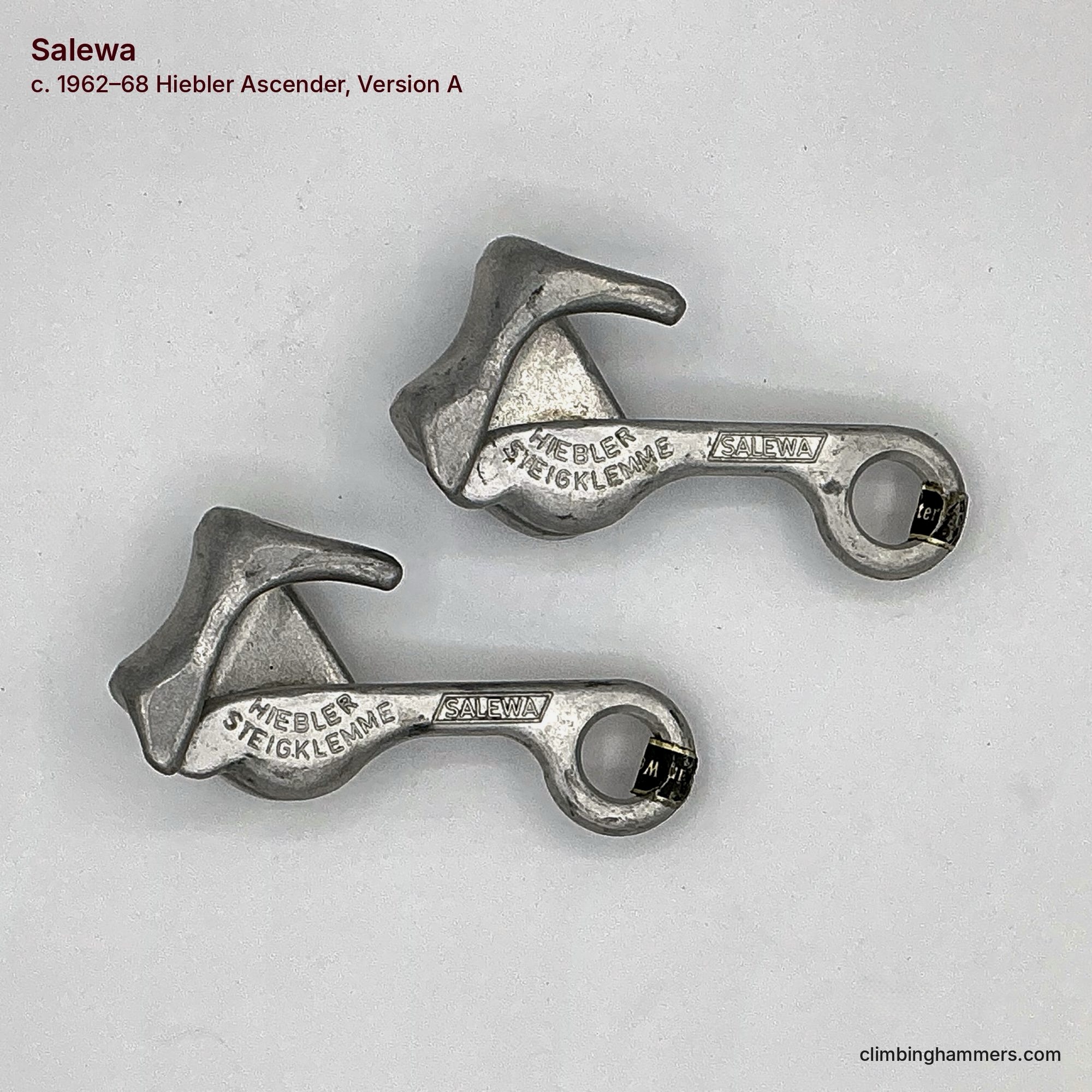
Rope clamps existed before this one, but they were heavy and bulky, and often difficult to get on and off the rope. In 1961 Anton Hiebler of Garmisch-Partenkirchen patented something better: a small forged aluminum clamp you could snap onto a rope anywhere, with one hand, with a spring inside to keep its jaw biting. Salewa sold it as the Hiebler Steigklemme (“climbing clamp”). It cost less than the Swiss Jumar and held better on icy rope, and it stayed on the market into the early 1980s.
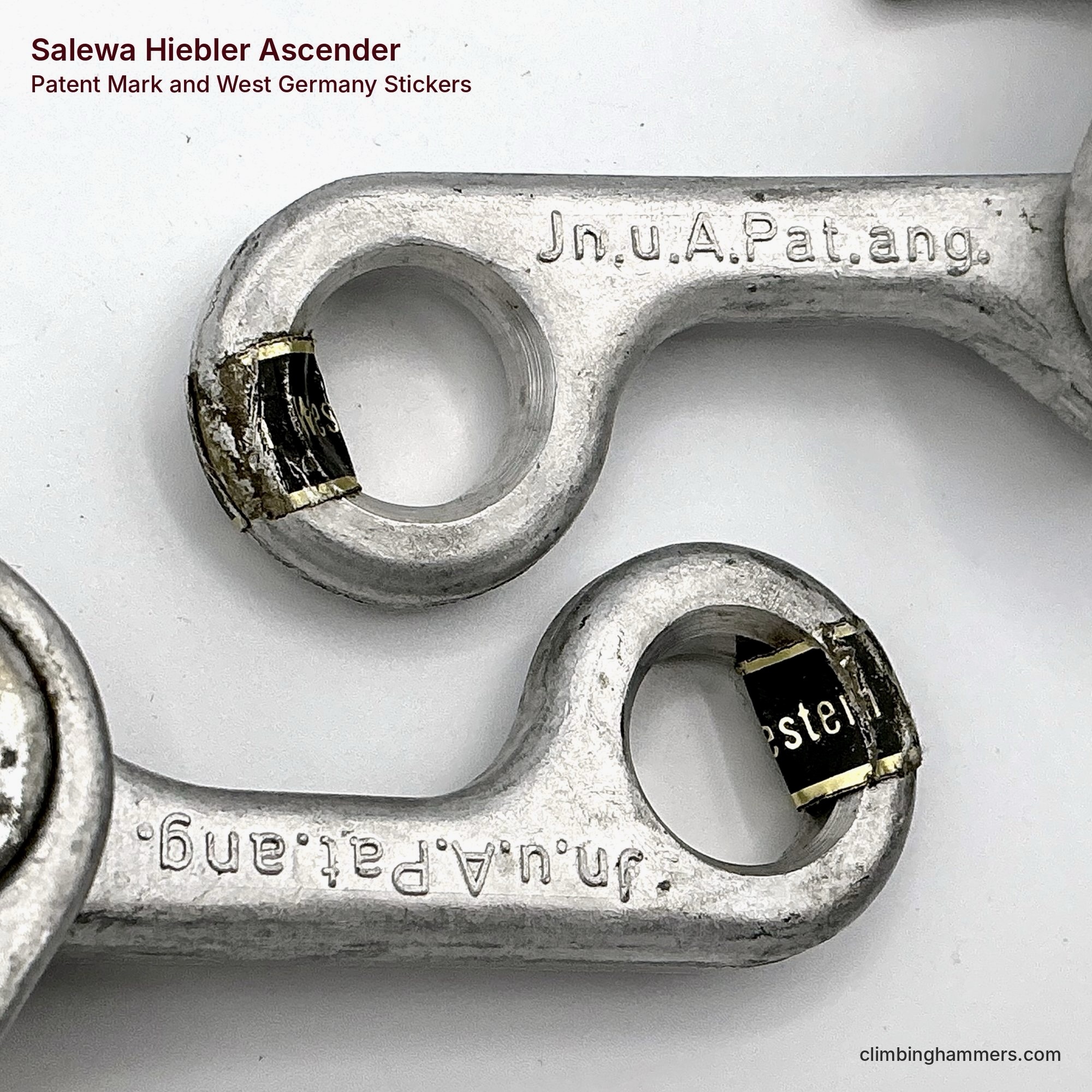
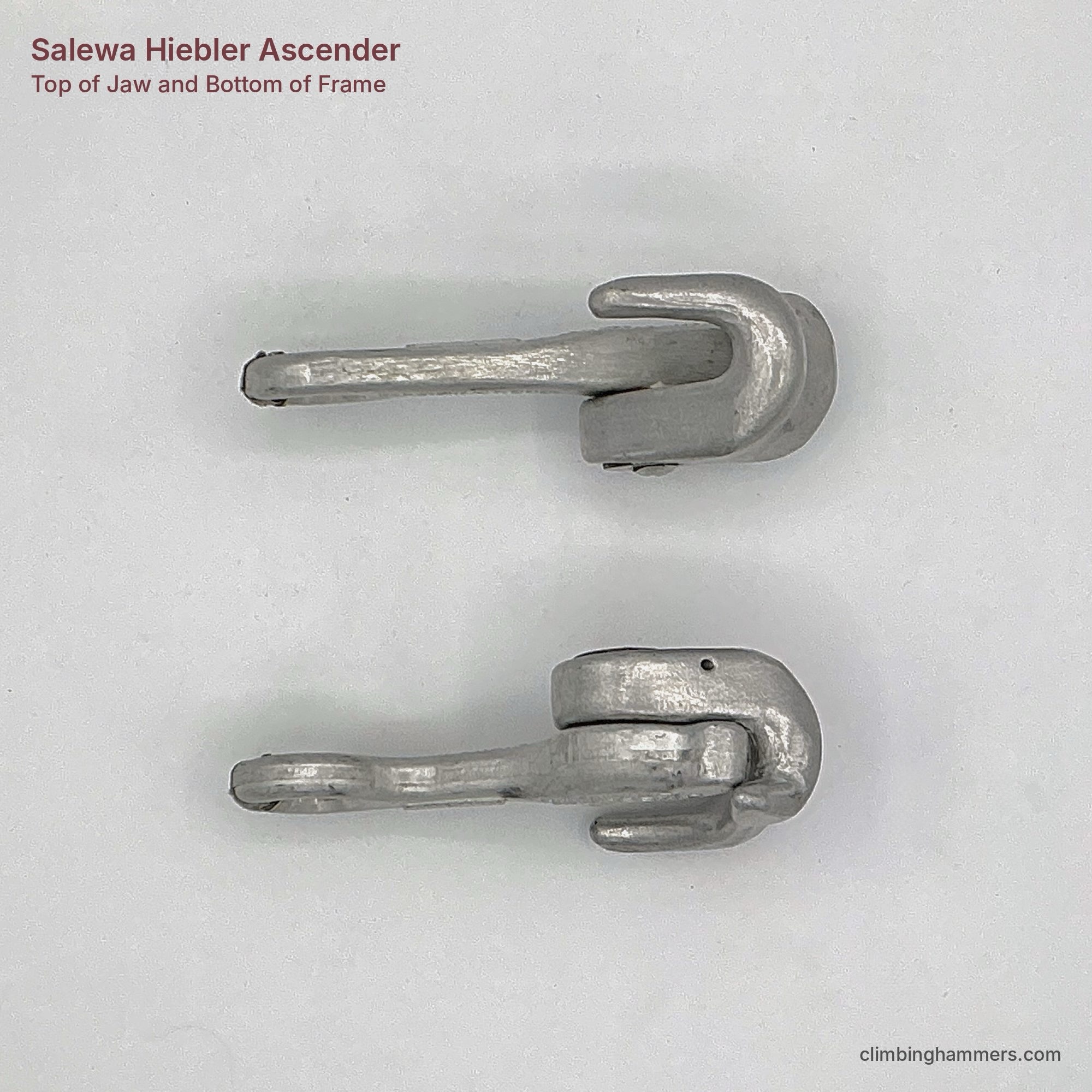
This pair is an example of the first version (Version A), before the safety clip, made about 1962 to 1968. They have never been used, and both still have their original “West Germany” stickers on the carabiner hole.
Identifying the Piece
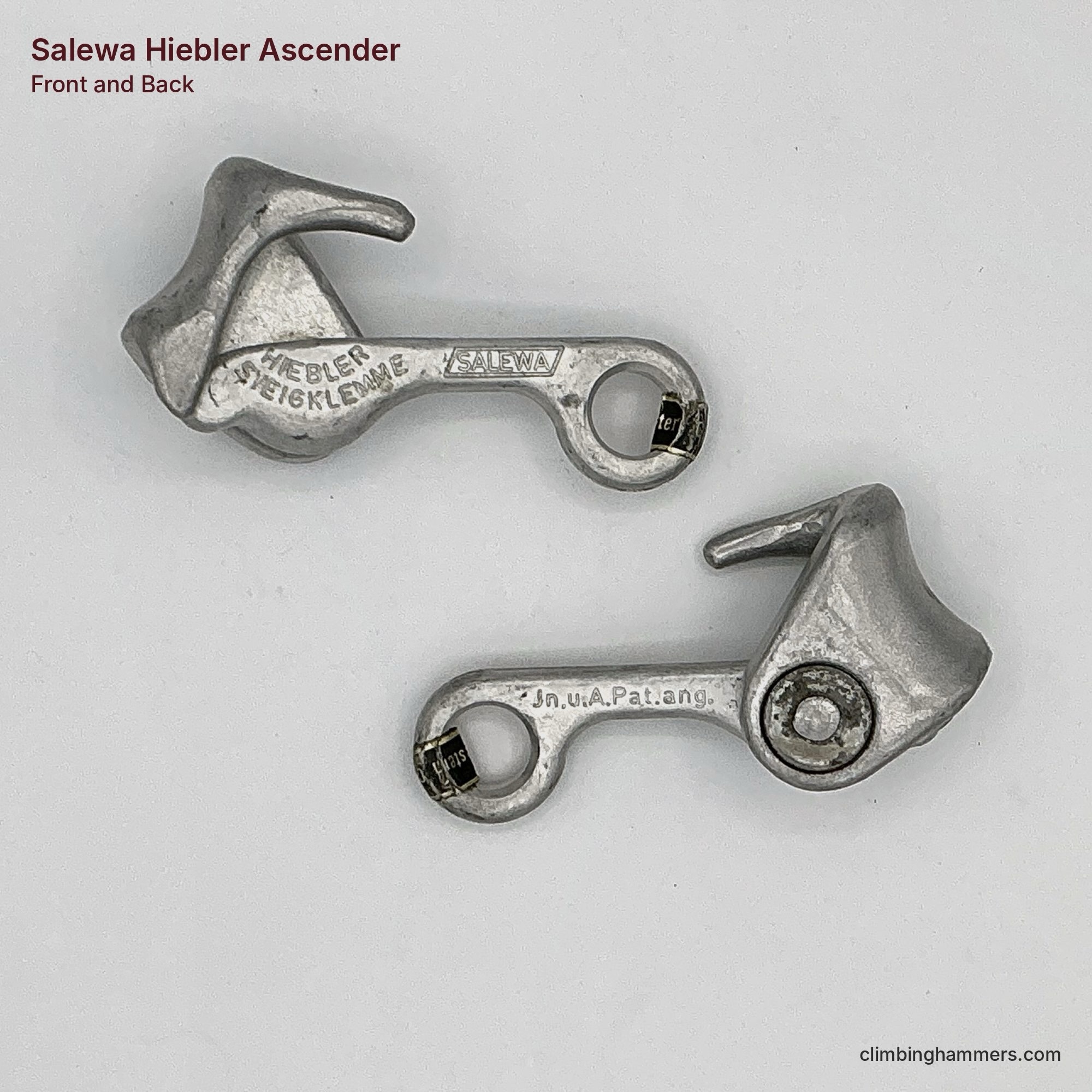
One face carries HIEBLER and STEIGKLEMME in raised letters, with SALEWA inside a parallelogram. The back is marked “Jn.u.A.Pat.ang.”, most likely short for In- und Auslands-Patent angemeldet: patent applied for at home and abroad. These marks appear on every version, so they don’t date a clamp on their own.
Who Invented It
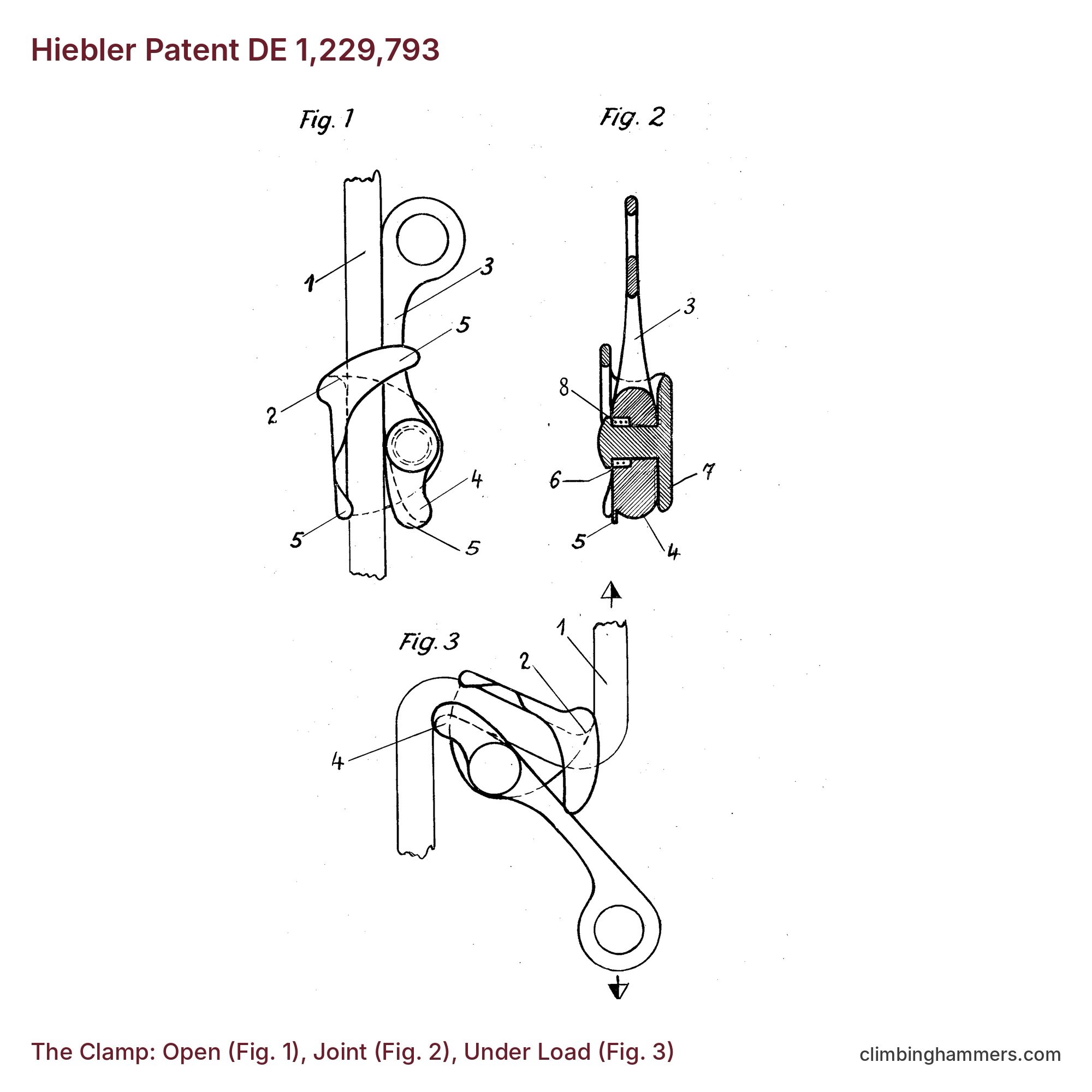
The clamp is often credited to Toni Hiebeler, one of the four climbers who made the first winter ascent of the Eiger North Face in March 1961. The patents point elsewhere. The German patent, DE 1,229,793 (filed 14 July 1961, granted 8 June 1967), and its Austrian counterpart, AT 238,077 (filed 1962, published 1965), both name Anton Hiebler of Garmisch-Partenkirchen, spelled as it is on the clamp. Salewa appears in neither. Hiebler held the patents himself, and Salewa made and sold the clamp. Vertical Archaeology reports the same conclusion from a source in contact with the inventor’s family.
The “Death Clamp” and the Safety Clip
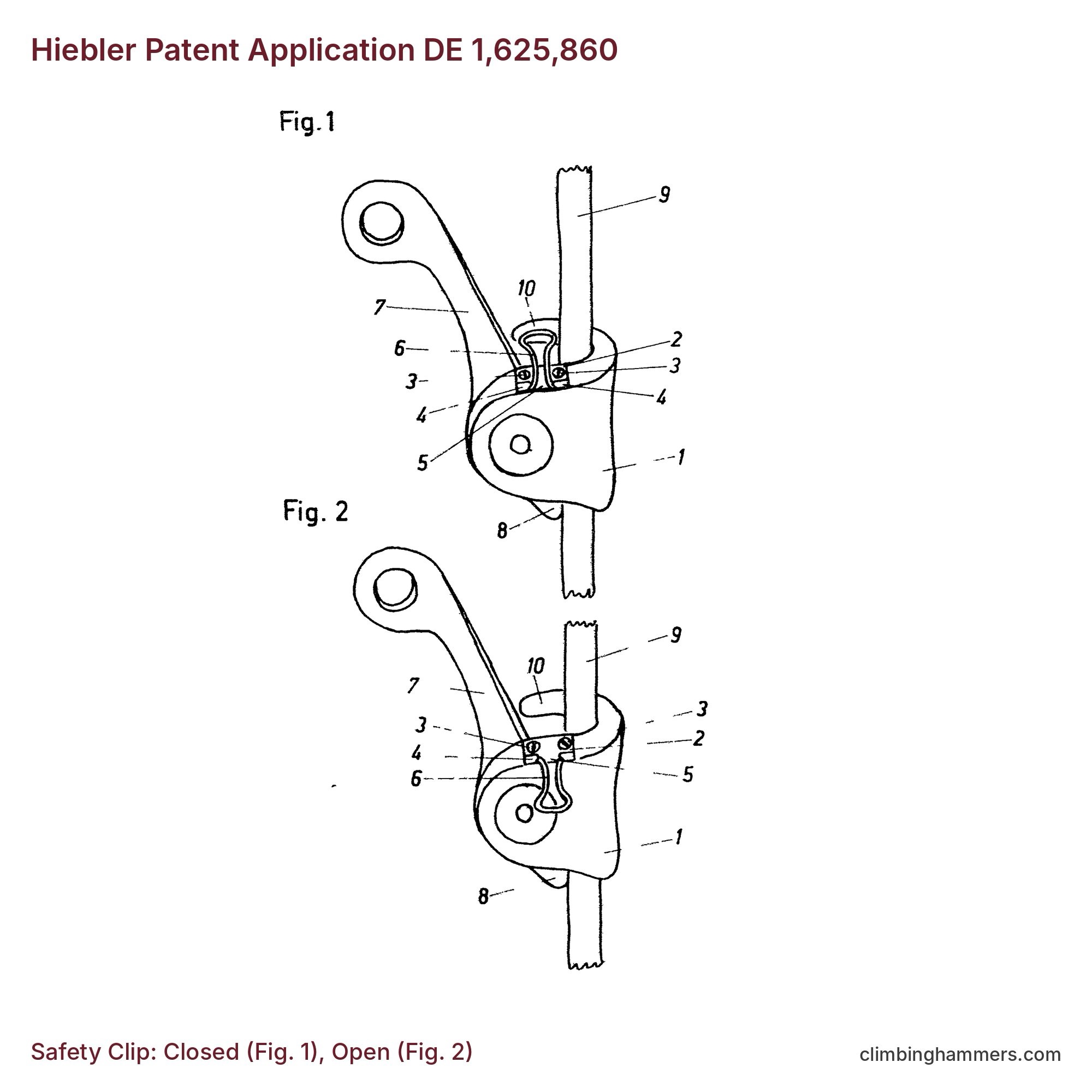
The design had a well-known flaw. Under load the clamp tended to turn on the rope, and the same movement that slid it upward could also open it, earning it the nickname “death clamp.” Hiebler addressed the problem himself. In October 1967 he applied for an addition to his patent, DE 1,625,860 (published 1970): a spring-wire locking bail mounted on top of the jaw. In the application he explains that climbers were using the clamp as a self-belay on fixed ropes, where it hung unloaded, could snag, and could be pulled open and off the rope. Snapped closed, the bail stops the lever from opening and covers the gap that thinner rope leaves between lever and jaw.
Dating This Piece
This pair has no clip and no screw holes on top of the jaw, and measures 46 mm tall, the size of the early version; the later free-standing clip models are about 49 mm. Each also has the small hole in the bottom of the frame recorded for that version. The clamp was in production by 1963, when it appeared in a Sporthaus Schuster catalog, and the clip came after Hiebler’s October 1967 application, which places this pair at about 1962 to 1968.
The Versions
Dr. Gary D. Storrick sorted the Hiebler into five versions on his Vertical Museum site, by size, weight and safety clip. His research is the standard reference for telling them apart, and is reproduced here with credit.1
| Version | Size, H × W × T | Weight | Safety clip | Notes |
|---|---|---|---|---|
| A | 46 × 107 × 30 mm | 109 g | None | Small hole in the bottom of the frame; matches the clamp patent drawing |
| B1 | 46 × 107 × 30 mm | 105 g | Thin wire bail on a stamped plate, screwed to the top of the jaw | Plate has parallel sides and rounded corners |
| B2 | 46 × 107 × 30 mm | 105 g | As B1 | Plate has diverging sides and sharp corners |
| C | 49 × 108 × 32 mm | 109 g | Binder-clip-shaped wire clip | |
| D | 49 × 107 × 33 mm | 110 g | Heavier wire clip | Clip is easily knocked open |
In short: no clip and 46 mm tall is a Version A. A screwed plate on top of the jaw is a B; the plate’s shape separates B1 from B2. A free-standing wire clip is a C or D. A C or D that has lost its clip can look like an A from above, but it stands about 3 mm taller.
One open question: the drawing in Hiebler’s 1967 clip application shows the bail held by a plate screwed to the top of the jaw, which looks like Version B, while Storrick links the patent to Version C. If you have a B or C to compare, let me know.
Sources: German Patent DE 1,229,793, Seilklemme, insbesondere für bergsteigerische Zwecke, and German Offenlegungsschrift DE 1,625,860, Sperrzunge für Seilklemme, both Anton Hiebler, from DEPATISnet (DPMA); Austrian Patent AT 238,077 B, Seilklemme, Anton Hiebler; Vertical Archaeology, Salewa Hiebler Ascender (2014); and the Whyte Museum of the Canadian Rockies, which holds Chic Scott’s Hiebler pair. Measurements and condition from the collection.
1 A note on Dr. Storrick’s research. The version data above comes from Dr. Gary D. Storrick’s page “Salewa Hiebler Steigklemme” on his Vertical Museum site. At the time of this post, the Vertical Museum had been taken down; it survives only as an archived copy on the Internet Archive’s Wayback Machine, and most of its photographs are already gone. His findings are reproduced here, with full credit to him, in an effort not to lose his research.

