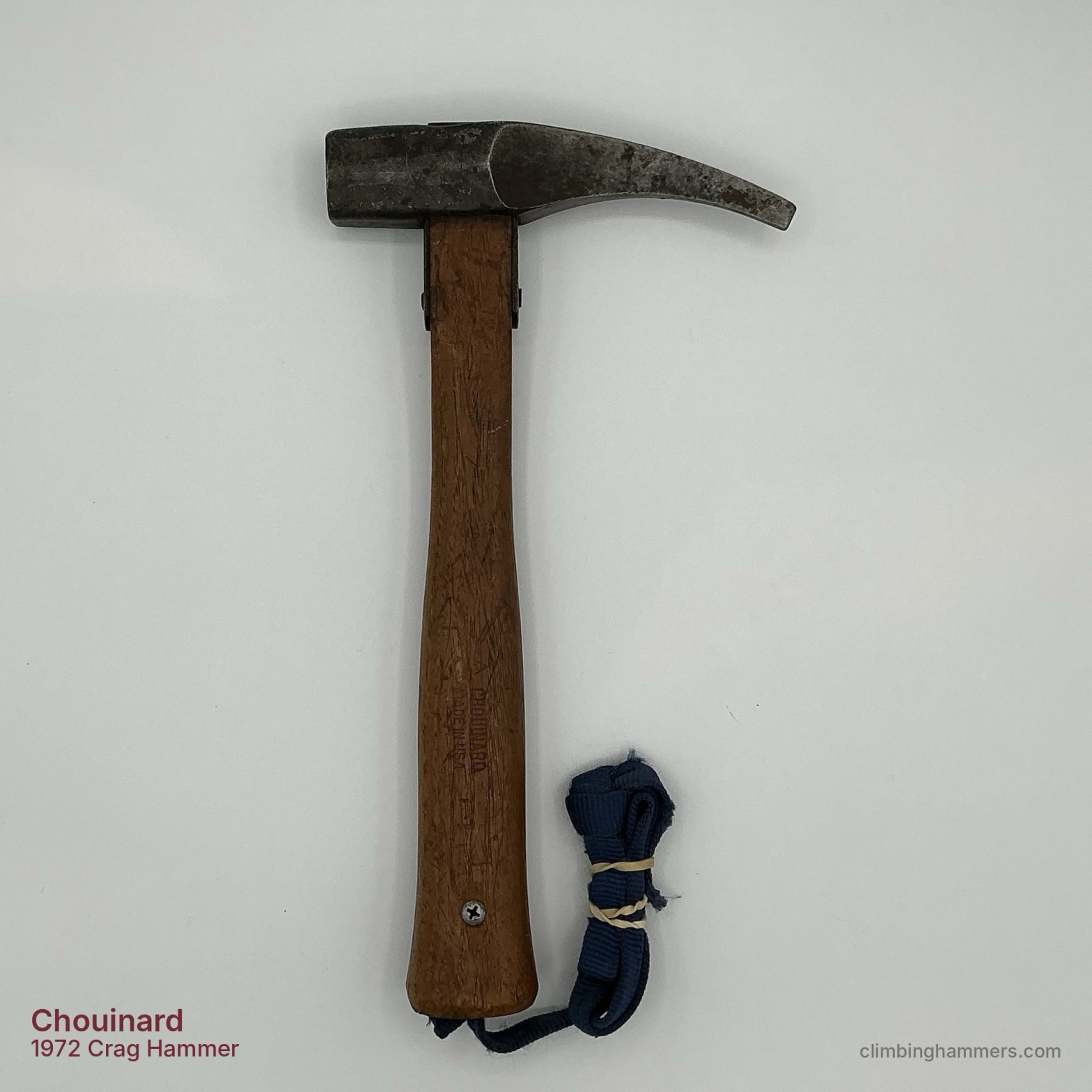
The first Chouinard Crag hammer, a lighter, trimmer hammer built for the new era of clean climbing.
Identifying Marks
- Long, thin, blunt pick with no teeth, thinner and shorter than the picks on Chouinard’s other hammers
- Solid head with no notch under the hammer face (the notch arrived in 1973–74)
- Wood handle stamped “CHOUINARD MADE IN USA” in red ink
- Phillips screw near the end of the handle, holding the leash
About the Model
The Crag hammer arrived in 1972, the same year Chouinard’s catalog called on climbers to give up pitons for nuts and hexentrics. It was Chouinard’s hammer for that new style. Instead of teeth for ice, it has a long, smooth, blunt pick for working stuck nuts and hexes out of cracks, prying out fixed pins, and scraping dirt and vegetation from cracks before placing protection. Later Chouinard catalogs describe it as a free-climbing tool, and in Yosemite it was often paired with a whisk broom for cleaning dirty jam cracks.
The standard Crag pick is smooth. The occasional Crag turns up with a tooth or two on the underside of the pick, and it isn’t always clear whether that’s an owner’s modification or a less common variant, so a toothed Crag is worth a closer look.
Sources: identifying marks and dates from the Karabin Climbing Museum‘s Chouinard Equipment display; pick design, notch date and catalog description from the Vertical Museum’s Chouinard hammer collection, which cites the 1978 Great Pacific Iron Works catalog; clean-climbing context from Patagonia’s history of the 1972 Chouinard catalog. Have something to add? Let me know.

